
Determining who is responsible for a truck accident is often far more complicated than it appears. Sometimes that’s true, but proving liability isn’t that simple.
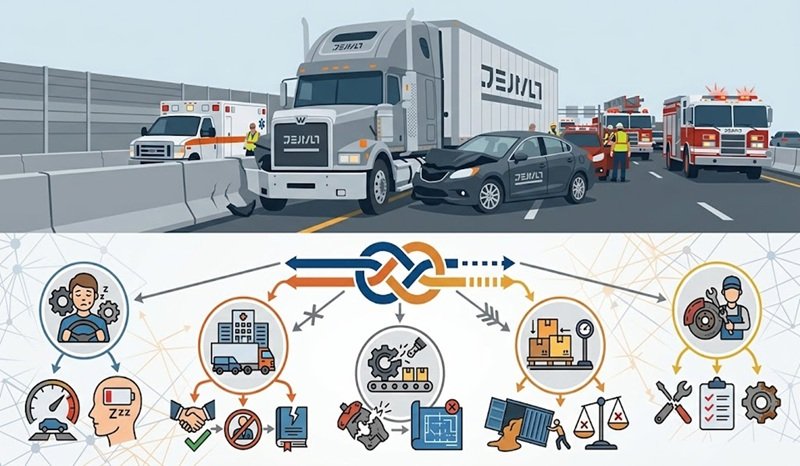
The trucking company, cargo loaders, maintenance shops, and parts manufacturers can all share responsibility depending on what happened.
That’s why investigators don’t just stop with the driver. They look at everything that led up to the crash.
In this article, we’ll explore truck accident liability, responsible parties, and the steps involved in proving fault. Also, we’ll break down factors that influence claims and protect their legal rights after a crash.
Why Truck Accident Liability Is More Complicated Than a Typical Car Crash
Truck accidents are more complicated than car accidents because they involve federal regulations, multiple liable parties, and larger insurance policies, all at the same time. If you suffered injuries in a crash, a Utah large truck accident lawyer can help identify who may be legally responsible and what evidence may support your claim.
Commercial trucks can legally weigh up to 80,000 pounds when fully loaded. Because of their size and weight, collisions often result in catastrophic injuries such as:
- Traumatic brain injuries
- Spinal cord injuries
- Multiple fractures
- Internal injuries
- Permanent disability
- Fatal injuries
These crashes are also more likely to be fatal than regular car accidents. But here’s where it gets complicated on the legal side too.
According to the National Highway Traffic Safety Administration (NHTSA):
“5,472 people died in large truck crashes in 2023, and 70% of those killed were occupants of other vehicles.”
You’re not dealing with one driver and one insurance policy. There’s the trucking company, contractors, cargo handlers, and sometimes a parts manufacturer. Federal rules from the FMCSA tell every one of those parties what they have to do. Violations of these safety regulations can become important evidence when determining liability.
These include:
| Entity | Core FMCSA Mandate | Key Compliance Focus |
| Trucking Company | Full Liability | Holds the DOT authority. Responsible for driver files, drug testing, Hours of Service (ELD logs), and maintenance. |
| Contractor | Follows Operating Authority | Leased: Must follow the hiring carrier’s safety and log rules. Own Authority: Takes on 100% of a trucking company’s rules. |
| Cargo Handler | Safe Loading & Fairness | Must secure cargo to prevent shifts. Legally banned from coercing or delaying drivers into violating driving hours. |
| Parts Manufacturer | Indirect (NHTSA Regulated) | No direct FMCSA rules. Must build parts to match the safety specs (brakes, lights) that carriers are required to use. |
Who Can Be Held Liable in a Truck Accident?
Several parties may be involved in a truck accident. So, liability depends on evidence of negligence, violations, or unsafe actions.
The Driver
A truck driver may be liable if he:
- Speeded or drove recklessly
- Drove while distracted
- Drove under the influence
- Drove while fatigued
- Violated Hours-of-Service rules
- Failed to drive safely for road conditions
The Trucking Company
A trucking company may be liable if it:
- Hired an unqualified driver
- Failed to train drivers
- Skipped maintenance
- Violated safety regulations
- Pressured drivers to break Hours-of-Service rules
- Allowed unsafe trucks on the road
Other Parties
It depends on the crash, but there may be others involved.
- A cargo-loading company can cause a wreck if they don’t secure the load right. An unbalanced or shifting load can make a truck nearly impossible to control.
- A maintenance shop can share blame if they missed something that should have been caught.
- A truck manufacturer can be responsible if a defective part contributed. Bad brakes. A faulty tire. It happens.
- In some cases, another driver or even a poorly designed road can be part of it.
And here’s something most people don’t realize: more than one party can be liable at the same time. That’s actually common in truck cases.
How Is Liability Proven After a Truck Accident?
A truck accident investigation involves a lot of pieces. This table shows exactly how liability is proven:
| Evidence | Why It Matters | The Risk of Delay |
| Police Report | Serves as the initial investigation starting point; rarely captures the complete story on its own. | Must be secured early but requires supplemental evidence. |
| Black Box (ECM) | Captures technical telemetry right up to the crash, including exact speed and braking data. | High Risk: Trucking companies are not required to keep this data forever; it can be overwritten or lost. |
| Electronic Logging Devices (ELDs) | Tracks driver hours to prove or disprove federal Hours of Service safety violations. | Subject to limited corporate retention windows before purging. |
| Dashcam Footage | Provides some of the most direct, objective visual evidence of the actual collision. | Can be recorded over or deleted if not preserved immediately. |
| Corporate Records | Includes driver qualification files, fleet maintenance logs, and cargo loading documentation. | Internal files can be legally destroyed after federal time limits expire. |
| Accident Reconstruction | Allows experts to work backward from vehicle damage and scene physics to explain the crash. | Physical evidence at the crash scene fades quickly due to weather and traffic. |
How Liability Affects Your Compensation
Who’s at fault determines who pays and how much coverage is actually available to you. Truck crashes typically involve bigger insurance policies than regular car accidents. So finding every responsible party can mean more money on the table.
You can go after compensation for medical bills, lost income, vehicle damage, and pain and suffering. If the injuries are permanent or someone was killed, damages are often substantially more serious, and the claim gets more involved.
Utah uses modified comparative negligence. That means if you’re found partly at fault, your compensation gets cut by that percentage. If you’re more than 50% at fault, you can’t collect at all. That’s why how the fault gets assigned matters so much.
What to Do If Liability Is Disputed?
In case liability is disputed, you should do these things:
- Get medical care: Early records link injuries to the crash.
- Save evidence: Keep photos, bills, and accident documents.
- Avoid admitting fault: Your statements can hurt your claim.
- Talk to a truck accident attorney: Before accepting a settlement, you should talk to a Utah truck accident attorney who can review your claim.
If you are injured in a truck accident in Utah, Hernandez Injury Law helps truck accident victims throughout Utah investigate liability, preserve evidence, and pursue compensation under Utah law.
Conclusion
Truck accident liability doesn’t stop at the driver but may include the company, a cargo handler, a maintenance shop, or a parts manufacturer. Any of them could share responsibility. The way to find out is through a real investigation with the right evidence.
If you’ve been in a truck accident, the first few days matter more than most people realize. Protect the evidence. Get medical care. Talk to an attorney before you talk to the insurance company. That’s the best position to be in.
FAQs
Is the truck driver always responsible?
Not always. The driver might be at fault, but they’re not always the only one, and sometimes they’re not even the main one. It depends on what caused the crash and who had a hand in it.
Can I sue the trucking company?
Yes, if the company’s actions helped cause the accident. Bad hiring, skipped maintenance, unsafe scheduling. The company doesn’t get off just because a driver was behind the wheel.
What evidence matters most?
Police reports, black box data, electronic logging records, dashcam footage, and maintenance documents tend to carry the most weight. Witness statements and accident reconstruction can also make a difference.
Can more than one party be responsible?
Yes, and it’s common. The driver, the company, a contractor, and a manufacturer. Any combination can share fault. It depends on the circumstances.


About the Author