For decades the choice was framed as either-or: leather uppers and dress-shoe character, or the grippy soles that wet floors, service shifts and festival tents actually demand — pick one. The framing is obsolete. Leather slip resistant shoes — genuine leather uppers built over engineered high-traction outsoles — now run a mature category serving hospitality workers, healthcare floors, kitchen shifts, wet-climate commuters and every festival-goer who has watched a beer-tent floor claim its first victim of the evening. The category has its own engineering, its own honest limits and its own buying screen, and this guide covers all of it: how slip resistance actually works, the leather-plus-grip construction, the occasion map from workplace to festival, the black-shoe register that dominates the category, and the screen-and-care system that keeps a pair performing.
How Slip Resistance Actually Works
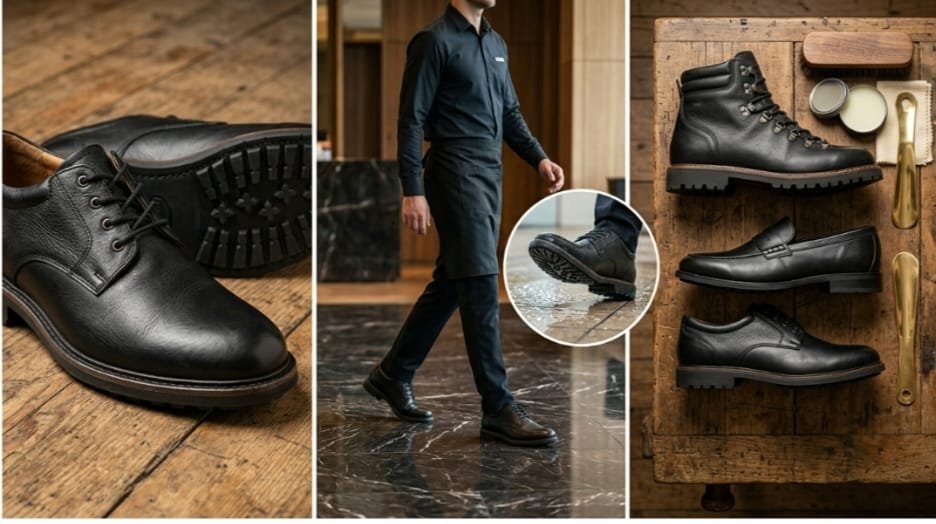
Grip is engineering, not marketing, and three factors produce it. The compound: slip-resistant outsoles run softer rubber formulations that conform to floor micro-texture — the material difference between a sole that skates on a wet surface and one that keys into it; the trade the compound makes (softer rubber wears faster than hard leather or dense rubber) is the category’s honest cost. The tread geometry: multidirectional lug and siping patterns channel liquid away from the contact patch — the aquaplaning logic, at shoe scale — with fine siping handling thin films (kitchen grease, spilled beer) and deeper lugs handling standing water and outdoor ground. The contact architecture: flatter, fuller-contact sole profiles maximize rubber-on-floor at every step angle, which is why the category’s builds look grounded rather than sculpted.
The mechanics’ buying translation: real slip resistance is visible — compound named, tread photographed, and on the certified tier, tested ratings stated — while “non-slip” as a bare adjective on a smooth-soled listing is the category’s most common fiction.
The Leather-Plus-Grip Construction
The category’s achievement is the marriage, and the construction is specific. The uppers: genuine leather doing what leather does — structure, breathability, water shrugging, the professional appearance service dress codes require, and the molding fit of the material everywhere else in the wardrobe; full-grain on the quality tier, treated finishes for the wet-work registers. The junction: proper bonding or stitching between leather upper and rubber outsole — the construction zone where the marriage succeeds or delaminates, and the close-photo check that separates the tiers. The midsection: cushioning and shanks rated for standing shifts, because the category’s buyers stand for livings — the comfort spec traveling with the grip spec everywhere the shoes actually sell. And the silhouettes: the range runs from work-dress derbies and service loafers through traditional builds — the Alpine shoe tradition’s leather-and-rubber combination soles being the heritage version of exactly this marriage, grounding festival outfits on tent floors for the same reasons.
The Occasion Map
The category serves named rooms. The service floors: hospitality, kitchens, healthcare — the home territory, where dress codes demand leather and floors demand grip, and where the certified-rating tier belongs. The wet-world commute: rain-climate daily wear — leather’s weather tolerance over soles that treat wet pavement as normal. The standing occasions: events, retail floors, long-shift days — the comfort-spec register. And the festival grounds: the map’s most underrated entry — beer-tent floors run wet from the first hour, fairground terrain runs uneven, and the traditional outfit’s grounded-sole heritage exists for exactly this; a leather-and-rubber soled pair beneath the festival build is the difference between dancing on the benches and starring in the evening’s cautionary tale.
The map’s shared thread: every room combines leather’s dress requirement with a floor that punishes smooth soles — the category’s whole reason to exist, stated as a checklist of places.
The Black Register
One colorway dominates the category, and the dominance is earned. Black leather non slip shoes own the service registers outright — the universal dress-code answer that matches every uniform, hides every shift’s scuffs, and polishes back to standard in a minute — which is why the category’s deepest ranges, widest sizes and best-tested builds all run black first. The register’s styling range: the black builds serve past the workplace — dark trousers and denim in the everyday register, the dressed-casual rooms where black leather always passed, and the formal-adjacent occasions where grip quietly matters (wet-weather weddings being the classic). The register’s one boundary, kept honest: beneath the traditional festival outfit, the leather-family law still governs — black grounds the dark builds and the formal register, while the brown family serves the classic tan-leather looks — the same harmonizing rule the whole wardrobe runs, unchanged by the outsole.
The register’s buying note: black’s dominance means it’s also where the fiction tier concentrates — the screen below applies hardest exactly where the choice is widest.
The Screen and the Care System
The category screens on both halves of the marriage. The grip half: compound and tread visible and named, certified slip ratings on the work tier, full-contact profiles — and the fiction filter: smooth-soled listings wearing the “non-slip” adjective fail on sight. The leather half: genuine named uppers, finished construction at the sole junction (the delamination zone, photographed close), and the standing-shift comfort spec where the wear is occupational. The fit note: sized for the socks and shifts of the actual use — service pairs over work socks, festival pairs over the wool system. And the care system that maintains both halves: the leather half runs the standard rhythm (wipe, dry naturally, condition seasonally, polish the black register weekly in service use) while the grip half runs its own — tread kept clear of embedded debris, soles checked for the wear-down that softly retires the compound’s grip, and the replacement honesty the softer-rubber trade demands: slip-resistant outsoles are consumables on service schedules, and the quality tier’s resoleable and replaceable-sole builds are the economics answer.
The system’s summary: maintain both halves and the marriage lasts — the leather aging into character while the grip stays rated.
Frequently Asked Questions
How do slip-resistant soles actually grip? Softer conforming rubber compounds, liquid-channeling tread geometry and full-contact profiles — engineering that’s visible and, on the work tier, certified.
Are leather uppers compatible with non-slip soles? That’s the category: genuine leather structure and appearance over engineered outsoles — with the junction construction as the quality zone to check.
Why are most of the category black? Service dress codes: black matches uniforms, hides shift wear and polishes back to standard — the register where the deepest ranges live.
Do festival outfits need slip resistance? More than most rooms — tent floors run wet and fairgrounds run uneven; the traditional leather-and-rubber sole heritage exists for exactly this.
What’s the biggest buying trap? The adjective tier: smooth-soled shoes labeled “non-slip” with no compound, tread or rating shown — real grip is always visible.
How long do the soles last? Shorter than hard soles by design — the soft-compound trade; the quality tier answers with replaceable and resoleable builds on service schedules.
For decades the choice was framed as either-or: leather uppers and dress-shoe character, or the grippy soles that wet floors, service shifts and festival tents actually demand — pick one. The framing is obsolete. Leather slip resistant shoes — genuine leather uppers built over engineered high-traction outsoles — now run a mature category serving hospitality workers, healthcare floors, kitchen shifts, wet-climate commuters and every festival-goer who has watched a beer-tent floor claim its first victim of the evening. The category has its own engineering, its own honest limits and its own buying screen, and this guide covers all of it: how slip resistance actually works, the leather-plus-grip construction, the occasion map from workplace to festival, the black-shoe register that dominates the category, and the screen-and-care system that keeps a pair performing.
How Slip Resistance Actually Works
Grip is engineering, not marketing, and three factors produce it. The compound: slip-resistant outsoles run softer rubber formulations that conform to floor micro-texture — the material difference between a sole that skates on a wet surface and one that keys into it; the trade the compound makes (softer rubber wears faster than hard leather or dense rubber) is the category’s honest cost. The tread geometry: multidirectional lug and siping patterns channel liquid away from the contact patch — the aquaplaning logic, at shoe scale — with fine siping handling thin films (kitchen grease, spilled beer) and deeper lugs handling standing water and outdoor ground. The contact architecture: flatter, fuller-contact sole profiles maximize rubber-on-floor at every step angle, which is why the category’s builds look grounded rather than sculpted.
The mechanics’ buying translation: real slip resistance is visible — compound named, tread photographed, and on the certified tier, tested ratings stated — while “non-slip” as a bare adjective on a smooth-soled listing is the category’s most common fiction.
The Leather-Plus-Grip Construction
The category’s achievement is the marriage, and the construction is specific. The uppers: genuine leather doing what leather does — structure, breathability, water shrugging, the professional appearance service dress codes require, and the molding fit of the material everywhere else in the wardrobe; full-grain on the quality tier, treated finishes for the wet-work registers. The junction: proper bonding or stitching between leather upper and rubber outsole — the construction zone where the marriage succeeds or delaminates, and the close-photo check that separates the tiers. The midsection: cushioning and shanks rated for standing shifts, because the category’s buyers stand for livings — the comfort spec traveling with the grip spec everywhere the shoes actually sell. And the silhouettes: the range runs from work-dress derbies and service loafers through traditional builds — the Alpine shoe tradition’s leather-and-rubber combination soles being the heritage version of exactly this marriage, grounding festival outfits on tent floors for the same reasons.
The Occasion Map
The category serves named rooms. The service floors: hospitality, kitchens, healthcare — the home territory, where dress codes demand leather and floors demand grip, and where the certified-rating tier belongs. The wet-world commute: rain-climate daily wear — leather’s weather tolerance over soles that treat wet pavement as normal. The standing occasions: events, retail floors, long-shift days — the comfort-spec register. And the festival grounds: the map’s most underrated entry — beer-tent floors run wet from the first hour, fairground terrain runs uneven, and the traditional outfit’s grounded-sole heritage exists for exactly this; a leather-and-rubber soled pair beneath the festival build is the difference between dancing on the benches and starring in the evening’s cautionary tale.
The map’s shared thread: every room combines leather’s dress requirement with a floor that punishes smooth soles — the category’s whole reason to exist, stated as a checklist of places.
The Black Register
One colorway dominates the category, and the dominance is earned. Black leather non slip shoes own the service registers outright — the universal dress-code answer that matches every uniform, hides every shift’s scuffs, and polishes back to standard in a minute — which is why the category’s deepest ranges, widest sizes and best-tested builds all run black first. The register’s styling range: the black builds serve past the workplace — dark trousers and denim in the everyday register, the dressed-casual rooms where black leather always passed, and the formal-adjacent occasions where grip quietly matters (wet-weather weddings being the classic). The register’s one boundary, kept honest: beneath the traditional festival outfit, the leather-family law still governs — black grounds the dark builds and the formal register, while the brown family serves the classic tan-leather looks — the same harmonizing rule the whole wardrobe runs, unchanged by the outsole.
The register’s buying note: black’s dominance means it’s also where the fiction tier concentrates — the screen below applies hardest exactly where the choice is widest.
The Screen and the Care System
The category screens on both halves of the marriage. The grip half: compound and tread visible and named, certified slip ratings on the work tier, full-contact profiles — and the fiction filter: smooth-soled listings wearing the “non-slip” adjective fail on sight. The leather half: genuine named uppers, finished construction at the sole junction (the delamination zone, photographed close), and the standing-shift comfort spec where the wear is occupational. The fit note: sized for the socks and shifts of the actual use — service pairs over work socks, festival pairs over the wool system. And the care system that maintains both halves: the leather half runs the standard rhythm (wipe, dry naturally, condition seasonally, polish the black register weekly in service use) while the grip half runs its own — tread kept clear of embedded debris, soles checked for the wear-down that softly retires the compound’s grip, and the replacement honesty the softer-rubber trade demands: slip-resistant outsoles are consumables on service schedules, and the quality tier’s resoleable and replaceable-sole builds are the economics answer.
The system’s summary: maintain both halves and the marriage lasts — the leather aging into character while the grip stays rated.
Frequently Asked Questions
How do slip-resistant soles actually grip? Softer conforming rubber compounds, liquid-channeling tread geometry and full-contact profiles — engineering that’s visible and, on the work tier, certified.
Are leather uppers compatible with non-slip soles? That’s the category: genuine leather structure and appearance over engineered outsoles — with the junction construction as the quality zone to check.
Why are most of the category black? Service dress codes: black matches uniforms, hides shift wear and polishes back to standard — the register where the deepest ranges live.
Do festival outfits need slip resistance? More than most rooms — tent floors run wet and fairgrounds run uneven; the traditional leather-and-rubber sole heritage exists for exactly this.
What’s the biggest buying trap? The adjective tier: smooth-soled shoes labeled “non-slip” with no compound, tread or rating shown — real grip is always visible.
How long do the soles last? Shorter than hard soles by design — the soft-compound trade; the quality tier answers with replaceable and resoleable builds on service schedules.


About the Author