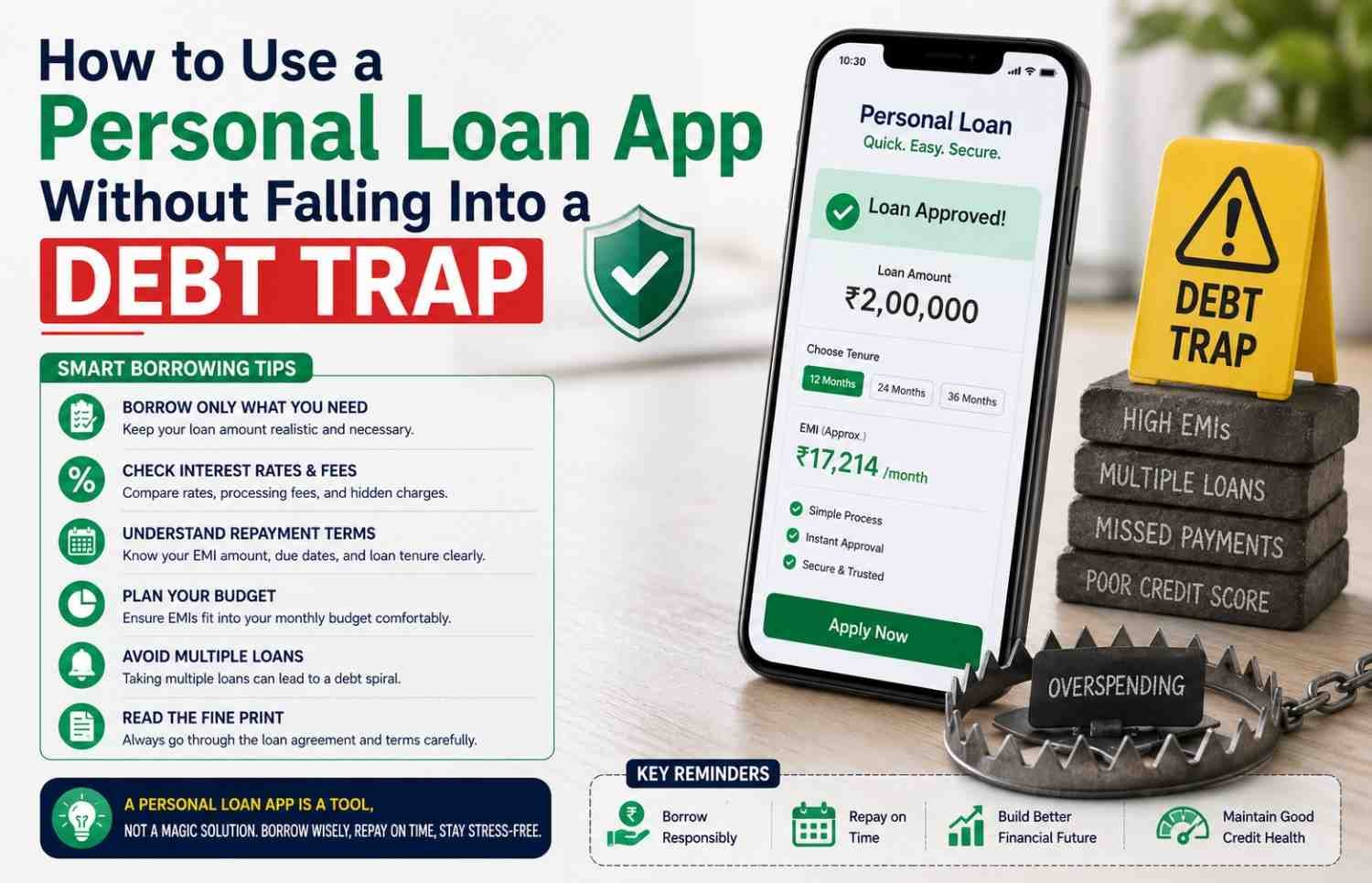
A personal loan app is one of the most convenient financial tools available in India today. Funds in your account within hours, no branch visits, no paperwork stacks, the ease is remarkable. But that same ease is precisely what makes it dangerous. When borrowing is as simple as tapping a screen, it becomes just as simple to borrow more than you should, more often than you need, until the EMIs from one loan are being covered by another, and a manageable need has quietly become an unmanageable spiral.
A debt trap rarely starts with a reckless decision. It starts with a series of reasonable-looking ones, a small loan here, a slightly larger one there, a new loan to smooth over a tight month. The convenience of the loan app removes the friction that once made people pause. Using these tools without falling into that trap isn’t about avoiding loans altogether; it’s about borrowing with discipline the app itself won’t enforce for you. Here’s how.
Understand How a Debt Trap Actually Forms
A debt trap is a cycle where your existing debt obligations grow faster than your ability to repay them, forcing you to borrow repeatedly just to stay afloat. It builds through a recognisable pattern:
You take a loan for a genuine need. The EMI is manageable at first. Then an unexpected expense hits, and rather than dipping into savings you don’t have, you take a second loan. Now two EMIs consume a larger share of your income. A tight month follows, and a third loan, or a credit card cash advance, covers the gap. Each new loan services the pressure created by the last, and the total debt compounds while your repayment capacity stays flat.
The warning sign is unmistakable once you know it: you’re borrowing to repay, not to fund something new. The moment a loan’s purpose is to cover another loan’s EMI, the trap has closed. Recognising this pattern early is the first defence against it.
Rule 1: Borrow Only for Genuine Needs, Never for Wants
The most fundamental discipline is distinguishing a need from a want before you borrow. A medical emergency, an essential home repair, education, or debt consolidation are needs; borrowing for them can be justified. A lifestyle upgrade, an impulse purchase, or funding a want you could save for instead rarely justifies the interest cost.
The convenience of a loan app blurs this line. When funds are 30 minutes away, the temptation to finance a want as if it were a need grows. Before every application, ask a simple question: Do I genuinely need this now, or do I want it and could save toward it? If it’s a want, the loan app is the wrong tool. Reserve borrowing for needs, and you eliminate the most common entry point into a debt spiral.
Rule 2: Keep Total EMIs Below 40% of Your Income
The single most important number in avoiding a debt trap is your total EMI-to-income ratio. Across all loans and credit cards combined, not just the new one, your total monthly EMI obligations should stay below 40% of your net monthly income.
This isn’t an arbitrary figure. Lenders themselves use a version of it, called FOIR (Fixed Obligation to Income Ratio), to assess whether you can afford a loan. If you earn Rs. 60,000 a month, your total EMIs should stay under Rs. 24,000. Crossing this threshold means debt is consuming so much of your income that any disruption, a delayed salary, a medical cost, a job change, pushes you toward borrowing again. Staying below 40% builds in the buffer that keeps one setback from becoming a spiral.
Before every loan, use the Bajaj Finserv EMI calculator to check what the new EMI does to your total ratio. If it pushes you past 40%, borrow less or don’t borrow at all.
Rule 3: Never Take a New Loan to Repay an Old One
This is the clearest line between healthy borrowing and a debt trap, and it deserves its own rule. Taking a fresh loan specifically to pay the EMI of an existing loan is the defining act of a debt spiral. It feels like relief in the moment, but it adds a new obligation on top of the old one and accelerates the compounding.
There’s an important exception: genuine debt consolidation. Taking one lower-interest personal loan to pay off multiple high-interest debts, like credit card balances at 36–42% p.a., is a legitimate financial strategy, because it reduces your total interest cost and simplifies repayment into one EMI. The distinction is direction: consolidation reduces your overall burden and interest rate; a rescue loan just delays and enlarges the same burden. If you’re consolidating to save on interest, that’s sound. If you’re borrowing to survive the next EMI, stop and seek a different solution.
Rule 4: Build an Emergency Fund So You Don’t Have to Borrow
Many debt traps begin with an unexpected expense that a person had no savings to cover. The medical bill, the car repair, the sudden travel, these are the moments that trigger the second and third loans. An emergency fund breaks this chain before it starts.
Aim to build 3 to 6 months of essential expenses in a separate, accessible account. This buffer means that when the unexpected happens, you draw from savings rather than reaching for another loan. It’s the structural difference between a household that absorbs shocks and one that borrows through them. Even a partial emergency fund, one month’s expenses, dramatically reduces the frequency with which you need to borrow at all.
Rule 5: Choose the Right Loan Structure and Tenure
How you structure a loan affects how easily you can repay it. A tenure that’s too short creates EMIs that strain your budget, increasing the risk of a missed payment or a rescue loan. A comfortable tenure keeps the EMI manageable and leaves room in your finances for everything else.
The rule is to pick the shortest tenure at which the EMI still sits comfortably within your budget, ideally at 25 to 30% of income, well below the 40% ceiling. Bajaj Finance’s Flexi variants add useful flexibility here: the Flexi Term Loan lets you draw only what you need and pay interest only on that amount, while the Flexi Hybrid Loan reduces initial EMIs by up to 45% during the early period. For borrowers managing tight cash flow, these structures reduce the monthly pressure that pushes people toward additional borrowing.
Rule 6: Use the App’s Tools to Stay in Control
A good personal loan app gives you tools that, used properly, actively prevent overborrowing. The mistake is using the app only to borrow, not to plan.
Before applying, use the eligibility calculator to see your realistic borrowing capacity without a hard inquiry, and the EMI calculator to model the monthly cost against your budget. After borrowing, use the app to track your outstanding balance, set up auto-debit so you never miss an EMI, and make part-prepayments when you have surplus, on Bajaj Finance Flexi variants, these are free and reduce both your interest and your outstanding faster. Checking for pre-approved offers before applying also avoids unnecessary hard inquiries. Treat the app as a planning tool, not just a borrowing tap, and it becomes a safeguard rather than a risk.
Rule 7: Avoid Multiple Simultaneous Applications
Applying to several loan apps at once, hoping one approves, or trying to stack multiple small loans, is both a symptom and a cause of debt trouble. Each application triggers a hard inquiry that lowers your credit score, and multiple active loans multiply your EMI burden quickly.
Discipline here is simple: apply to one lender at a time, for one loan at a time, only when you have a genuine need and the capacity to repay. Resisting the urge to borrow from multiple apps simultaneously keeps both your credit score and your total obligations under control. If one loan doesn’t meet your need, the answer is to reassess the need, not to open three more apps.
Recognising the Warning Signs Early
Catching a debt trap early is far easier than escaping one. Watch for these signals:
- You’re using one loan or credit card to pay another’s EMI
- Your total EMIs exceed 40% of your income
- You’re applying for new loans more frequently than before
- You have no emergency fund and rely on borrowing for any unexpected cost
- You’re only paying the minimum due on credit cards while balances grow
- You feel anxious about your EMI dates each month
If two or more of these apply to you, pause all new borrowing immediately. Focus on repaying existing debt, starting with the highest-interest obligation, and consider consolidating high-interest debts into a single lower-rate personal loan to reduce the total burden.
The Bottom Line
A personal loan app is a powerful tool that becomes a trap only when used without discipline. The convenience that makes it valuable, instant funds, no friction, is exactly what requires you to supply the discipline the app won’t. Borrow only for genuine needs, keep total EMIs below 40% of your income, never take a loan to repay another, and build an emergency fund so you rarely have to borrow in the first place.
Used this way, a regulated personal loan app like Bajaj Finserv is a genuine financial asset, a fast, transparent way to meet real needs when they arise. The tool isn’t the danger; undisciplined use is. Before every application, verify the app on the RBI’s Digital Lending Apps directory, model the EMI against your budget, read the Key Fact Statement for the APR, and borrow only what a genuine need requires and your income can comfortably repay. Handled with care, a loan app helps you navigate life’s expenses. Handled carelessly, it navigates you into a trap. The difference is entirely in how you use it.


About the Author