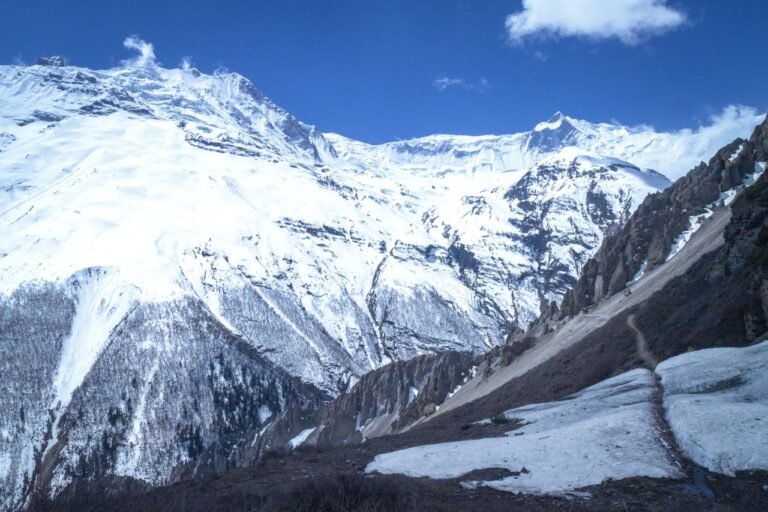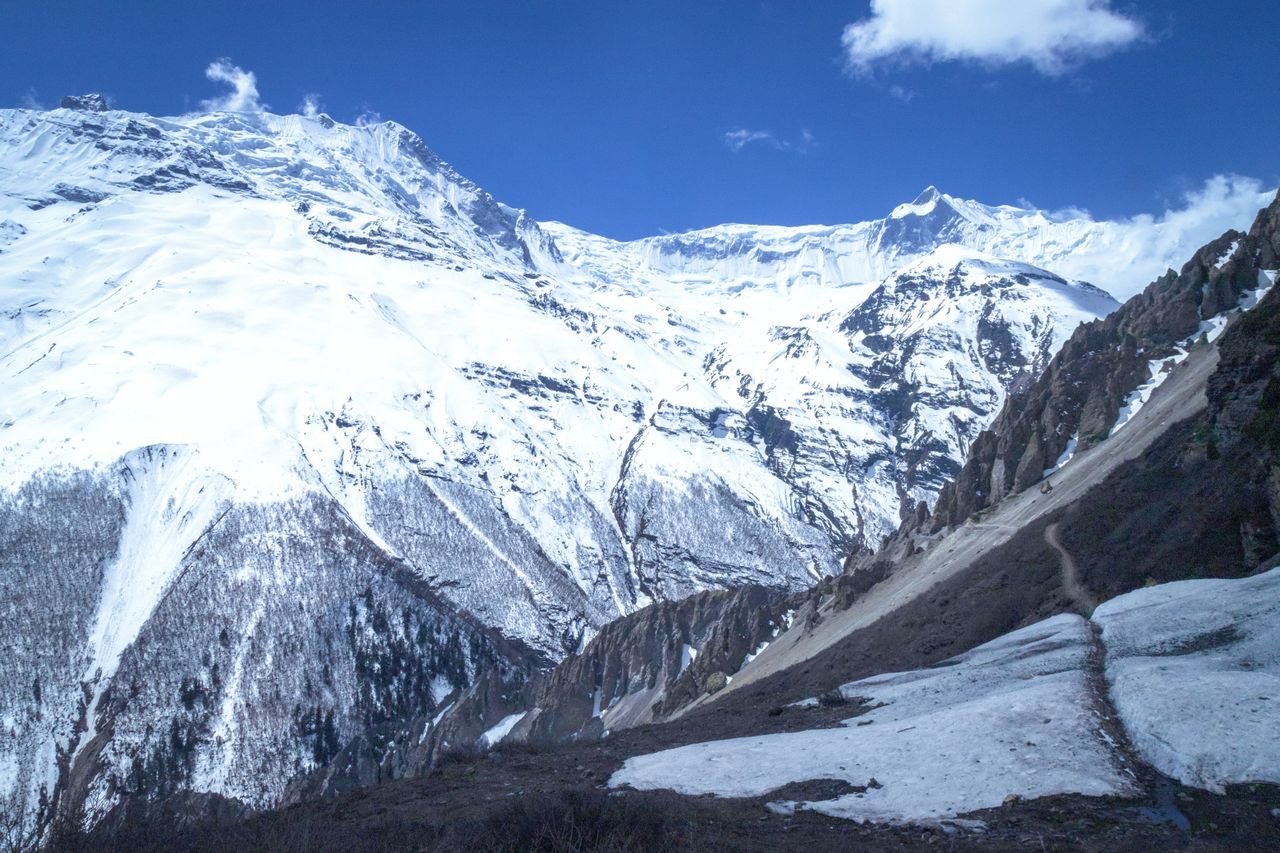
Overall, the Annapurna Circuit Trek is fairly strenuous to arduous. Although technical climbing is not required, good physical fitness, acclimatization, and preparation are a must as the route takes you up to the Thorong La Pass at 5416m (17769ft). The long days on the trail, ascents and descents, varied terrain, and high altitude make it a more strenuous trekking experience than most other Himalayan routes at a lower altitude.
The exciting bit is, that if done correctly; the Annapurna Circuit can still be done by a lot of first time Himalayan trekkers. However, it is going to be dependent on factors such as: your fitness; trekking experience; acclimatization; the weather; the route conditions; your attitude towards altitude etc.
How challenging is the Annapurna Circuit Trek?
Annapurna Circuit Trek is not considered as technically challenging but is physically challenging. Most part of the trek route is on a well established mountain and village trail. Trekkers walk on rocky stairs, stone paths, suspended bridges and dirt roads. Rope, crampons, and mountaineering skills are not required in this trekking route.
But the real problem is altitude. The trail slowly ascends from the lower valleys to Manang, finally culminating at the Thorong La Pass. As you climb up, the higher you go, the less oxygen you get and the more time your body needs to adjust.
Time spent per trekking day. The average length of a trekking day (excluding the walking days in Kathmandu or Jomson) varies according to itinerary and type of path but most of the time ranges from 5 to 8 hours. Several days are likely to be longer or shorter. Running repetitively the pattern ‘uphill walking – downhill walking – crossing unlevelled paths’ is likely to be tiring, especially on trekking days before Thorong La.
Annapurna Circuit Trek Difficulty by Altitude
Altitude is arguably the most important aspect in understanding the Annapurna Circuit Trek Difficulty. As the trek starts in rather low hill areas then slowly enters into the high Himalayan region. The gradually occurring altitude change can help in the adaptation process although the risk also grows with the altitude.
Perhaps the most important stage is the way to Manang, and then an acclimatisation before moving on to the higher settlements. Manang is approximately 3,540 meters, and most stories report an acclimatisation here. From here, the way goes from Manang toward the Yak Kharka and Thorong Phedi then on to the big crossing of Thorong La.
Thorong La, at 5416 meters, is the highest elevation of the trek. The hike from the early morning can be difficult because of the altitude, cold temperatures, strong wind, and strenuous trail. The trip to Muktinath, after the pass, is welcomed by the lower elevation and more hospitable conditions.
Physical Fitness Required for the Annapurna Circuit
You don’t have to be an athlete to trek but you do need a reasonable level of cardiovascular fitness and leg strength. The ability to walk for a few hours at a time is more crucial than speed.
Prior to the trek, you can prepare by walking, hiking, climbing stairs, cycling, jogging, or participating in other aerobic exercises on a regular basis. Greater endurance for daytime walking can be developed by doing extended weekend hikes. Strengthening the muscles in your legs and core can facilitate the ascent and descent of steep slopes.
Progressively longer and harder. Coming from a low elevation and having limited hiking experience, for example, you would want to start training many weeks in advance of the trek.
Thorong La Pass: The Most Difficult Section
Thorong La Pass can be the most challenging part of the Annapurna Circuit Trek for most trekkers as it is physically demanding and reaches an elevation of 5,416 meters (17,769 ft). Normally the ascent starts very early in the morning, as weather conditions can get worse later.
From Thorong Phedi or High Camp, it is a long climb uphill over rocky and, in place, snow-covered edges, depending on the time of year. This could be regarded as a non-technical climb, although the thinning air did slow our breathing.
On reaching the pass the challenge is not over. The trail to Muktinath is an arduous descent that can be hard on your knees and ankles. Trekking poles can really help out on this.
Trail and Terrain Difficulty
One of the reasons the Annapurna Circuit is so fascinating is its topography. Going higher up the trek, one encounters country lanes, forests, thickets and suspension bridges; above that there are bare slopes and rocky countryside.
Certain sections of the classic trail have been impacted by road building, and trekkers may find some sections to be jeep roads. Transportation may be used, depending on the itinerary, to skip certain road sections and save trekking time.
Another aspect that can make the trek exhausting is the rocky, step nature of the path and the uneven trails. It is often better to walk at an easier pace rather than attempting to walk quickly.
How Weather Affects Trek Difficulty
Weather. Weather conditions can dramatically increase the level of difficulty of the Annapurna Circuit. Spring and autumn trekking seasons tend to provide better conditions, however mountain weather can still change rapidly.
Colder at Thorong La. The winds at high altitude can make snow and cold a problem.
In the monsoon season there can be rain, wet tracks, mud, frozen and slippery conditions in the lower reaches. In winter there can be snow and freezing conditions higher up, and snow can sometimes block the Thorong La.
Therefore, selecting the correct season and bringing proper clothing and gear can make hiking much more comfortable.
Altitude Sickness and Annapurna Circuit Difficulty
Altitude sickness is a major concern while trekking the Annapurna circuit as the route goes over 5,000m. Even the strongest of trekkers can get symptoms of altitude sickness.
Early symptoms such as headache, fatigue, dizziness, anorexia and sleep disturbances are often dismissed. Care should be taken to avoid progression of symptoms by ascent rates that are sufficiently slow, and the use of rest days. Adequate fluid intake should be taken and strenuous activity avoided.
When symptoms are worse or more severe, a descent to a lower altitude is advisable. The itinerary should not involve excessive altitude progression and should incorporate proper acclimatization.
Is Annapurna Circuit Trek a Good Entry Level Trek?
Sure! Anyone can do the Annapurna Circuit Trek, beginners included. The only conditions are being in good shape (which the taking it slow and dodging all mountains do encourage!) and adhering to the proper directions. Prior experience in high altitude treks is beneficial, however not essential.
For first-timers, the most common mistake is heading out as though it is a race. Going slow, stopping frequently, eating regularly, hydrating regularly and listening to your body is far more important than how quickly you are moving.
In general, a longer itinerary is more suitable for people with less experience on trekking. This is because it allows more time for acclimatization and recovery. For inexperienced trekkers, trekking with an experienced guide is also wise, especially if they are new to high-altitude environments.
Tips to Make the Annapurna Circuit Easier
Much of the difficulty of the Annapurna Circuit can be eased by good preparation. Begin your physical training several weeks before you leave, and incorporate walking up hills, or stair climbing, into your regime. Take time to wear your trekking shoes before you arrive in Nepal so you do not develop blisters while walking.
Pack suitable for season, not what you think you may need. Carrying too much is no problem, but not carrying enough is. A decent pair of hiking shoes, warm clothing layers, protective waterproofs, padding poles, gloves, an enjoyable pack and a solid water bottle or hydration system.
The single most important thing: Walk at a slow, steady speed. Don‘t make up for your slow beginning by walking very quickly later in the day. Think all along about how to keep a little bit of extra energy, in reserve, for the whole journey.
Annapurna Circuit Trek Difficulty Compared With Other Treks
Compared with the Ghorepani Poon Hill Trek, which is a relatively short trek at lower elevations, the Annapurna Circuit trekking experience is comparatively harsher due to its relatively longer trekking days at much higher elevations.
However, in comparison with the Everest Base Camp Trek, the trek may not be too different in terms of physical challenge and although the challenge is different again. The challenge of the Annapurna Circuit trek is mainly the crossing of high Thorong La Pass, whereas the challenge of the Everest Base Camp trek is the long daily days of high altitude exposure.
In general, the Annapurna Circuit is less technically challenging than the ascents of peaks like Island Peak or Mera Peak because a regular circuit trek does not necessitate any mountaineering skill.
Also Read: Vietnam in September: Weather, Places to Visit & Travel Tips
Final Verdict: Is the Annapurna Circuit Trek Difficult?
As a whole, the Annapurna Circuit Trek Difficulty is moderate to difficult and altitude is the major concern. Trek does not involve any technical climbing but you need to be physically fit, well acclimatized, equipped and mentally prepared to succeed.
The hardest part is the Thorong La Pass at 5,416 meters which is difficult especially because of the early start, the steep climb, the cold and the lack of oxygen. However with a good schedule and being well prepared it can be done by fit beginners and experienced trekkers.
The main thing is to not take the mountains lightly. Prepare your body for the trek, go slowly when going up the mountain, keep an eye out for symptoms of altitude sickness and allow yourself plenty of time to enjoy it. If you do this, the Annapurna Circuit is a challenging yet enjoyable Himalayan trek.


About the Author